Why 80% of AI Projects Fail to Scale
The real reasons AI initiatives stall—and a proven framework to beat the odds and deliver measurable ROI.
Practical insights, tips, and strategies to help your business leverage AI for growth and efficiency.
From automating customer responses to streamlining your workflow, AI is no longer just for big corporations. Here's how small businesses can leverage AI to compete bigger and work smarter—not harder.
AI by Storm Team
April 2026 • 5 min read
Stay updated with the latest insights on AI for small businesses
The real reasons AI initiatives stall—and a proven framework to beat the odds and deliver measurable ROI.
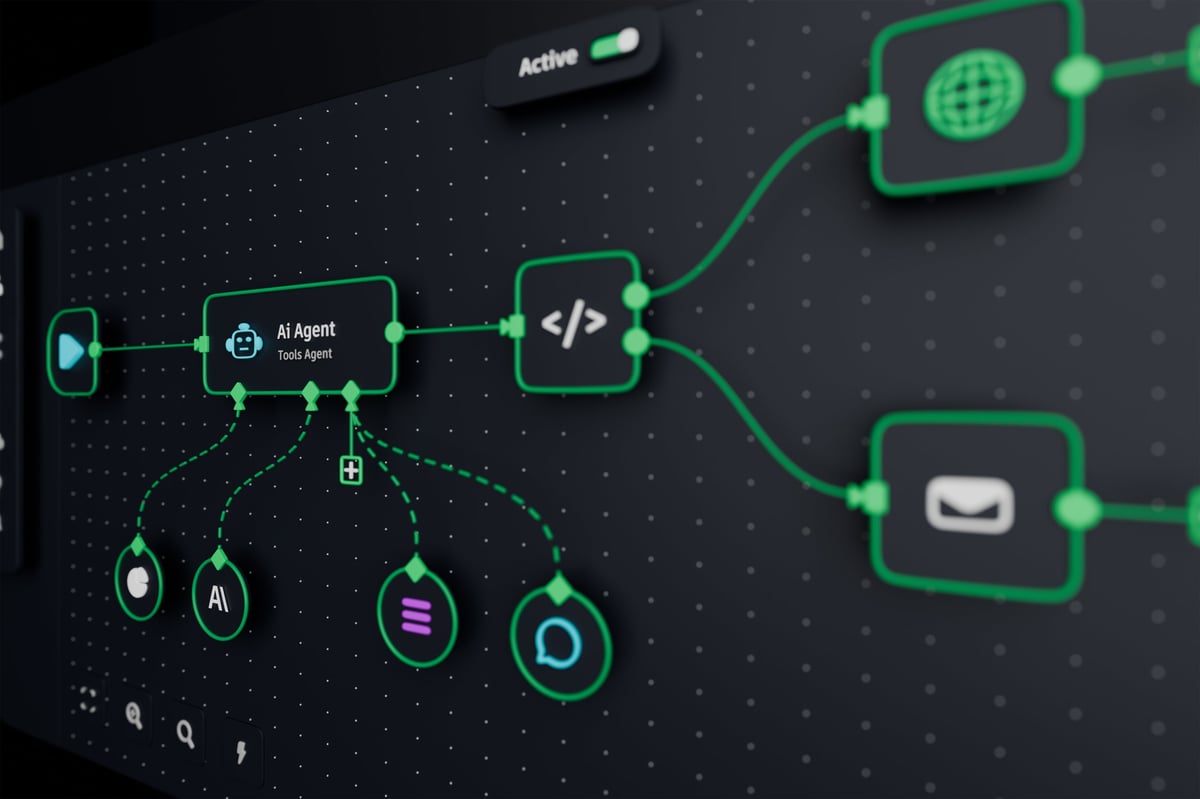
Agentic AI represents a shift from simple responses to autonomous systems that research, decide, and act.
Track response time, conversion rates, cost per acquisition, and more. See positive ROI in 60-90 days.
TL;DR: 80% of AI projects fail to scale because companies focus on technology instead of business outcomes. Success requires starting with clear ROI metrics, executive ownership, and treating AI as a cultural transformation, not just a software upgrade.
Your competitors aren't just talking about AI anymore—they're implementing it. But here's the uncomfortable truth: most AI initiatives never reach their full potential. Here's how to beat the odds.
After working with hundreds of businesses on AI implementation, we've identified the top reasons projects stall:
| Failure Reason | Impact | Fix |
|---|---|---|
| No clear ROI metric | Can't measure success | Define KPIs upfront |
| Technology-first approach | Solutions miss business needs | Start with problems |
| No executive sponsor | Projects lose priority | Assign ownership |
| Cultural resistance | Low adoption rates | Change management |
The businesses that win with AI follow a proven formula:
Most pilot programs show results within 4-8 weeks. Full organizational rollout typically takes 3-6 months.
Costs vary widely based on scope. A focused pilot program can start as low as $2,000/month, while comprehensive solutions may require $10,000+ monthly investment.
Not necessarily. Partner with an AI consultancy that handles implementation while training your team.

TL;DR: Agentic AI represents a fundamental shift from simple chatbots to autonomous digital colleagues that can research, decide, and act on your behalf—reducing costs by 60-80% while improving response quality.
The chatbot era is ending. The future belongs to AI agents—autonomous systems that don't just respond to queries, but actively work to solve problems on your behalf.
Unlike traditional chatbots that follow scripts, Agentic AI systems can:
| Capability | Chatbot | Agentic AI |
|---|---|---|
| Response time | Seconds | Instant + actions |
| Multi-step tasks | ❌ Limited | ✅ Full autonomy |
| Data integration | ❌ Basic | ✅ Deep integration |
| Cost reduction | 20-30% | 60-80% |
High-volume, rule-based tasks like lead qualification, appointment scheduling, customer follow-ups, and data entry are ideal starting points.
Yes, when properly implemented with enterprise-grade security. Look for solutions with SOC2 compliance and data encryption.
Most organizations see working prototypes within 2-4 weeks. Full deployment typically takes 6-8 weeks.
TL;DR: To measure AI ROI, track these 5 key metrics: response time reduction, lead conversion rate, cost per acquisition, customer satisfaction scores, and time saved per employee. Most businesses see positive ROI within 60-90 days.
You wouldn't invest in new equipment without measuring its impact on productivity. AI deserves the same rigorous approach. Here's how to prove—and improve—your AI investment.
What to measure: Average time from lead contact to first response
Industry benchmark: 47 hours → Under 5 minutes with AI
ROI impact: 100x more likely to connect with lead
What to measure: Percentage of leads that become customers
Industry benchmark: 10-15% → 25-40% with AI
ROI impact: 2-4x improvement in close rates
What to measure: Total cost to acquire one customer
Industry benchmark: 30-50% reduction with AI automation
ROI impact: Lower customer acquisition costs
What to measure: Post-interaction satisfaction scores
Industry benchmark: Improvement of 15-25%
ROI impact: Higher retention and referrals
What to measure: Hours saved on manual tasks per week
Industry benchmark: 10-20 hours/week per employee
ROI impact: Redirected capacity to revenue activities
Monthly AI Investment: $3,000
Additional Revenue from Lead Conversion: $45,000
Cost Savings from Automation: $12,000
Net Monthly ROI: $54,000
Return Multiple: 18x
Most AI investments show 300-500% ROI within the first year. Exceptional implementations can see 1000%+ returns.
Initial metrics appear within 2-4 weeks. Full ROI typically materializes within 60-90 days.
Yes. Create a dedicated AI budget line and track metrics specifically tied to AI-driven activities.
TL;DR: A Human-in-the-Loop (HITL) framework ensures AI augments human decision-making rather than replacing judgment entirely. The key is identifying the right checkpoints—typically at high-stakes decisions, ambiguous cases, and customer-facing communications.
AI doesn't replace human judgment—it amplifies it. The most successful AI implementations maintain human oversight where it matters most. Here's how to build a framework that gets the best of both.
Not every decision needs human involvement. Focus on these key areas:
Identify every decision point in your processes
Low / Medium / High / Critical stakes
Assign human reviewers for high-risk decisions
Clear routes for AI to flag concerns
Track where humans override AI and why
No. HITL only applies to high-stakes decisions—typically 5-15% of total volume. The remaining 85-95% remain fully automated.
Track escalation rates, human override rates, and resolution times. Improving these metrics shows the framework is working.
Many businesses start with part-time oversight (1-2 hours daily) and scale up only if escalation volume increases.
Get the latest AI insights and tips delivered straight to your inbox. No spam, just valuable content.